Safety in autonomous driving depends not only on accurately perceiving the surrounding environment but also on anticipating other road users' actions in time. Highway lane changes are particularly important because they involve interactions among multiple vehicles and can rapidly alter trajectories. Yet accurate anticipation alone is insufficient. In real-world driving, sensor observations may be incomplete, predictions may fluctuate over time, and models’ confidence levels may not reflect their actual predictive reliability. Our research therefore addresses not only prediction accuracy but also robustness to missing observations, temporal consistency, and the computational efficiency required for real-time applications. We examine these challenges by considering three possible driving intentions: maintaining the current lane, changing to the left lane, and changing to the right lane. For prediction horizons of one to six seconds, our approach estimates the probability of each intention and updates these estimates continuously as new observations become available.
We formulate lane-change intention anticipation as a sequential probabilistic inference problem. At each time step $t$, the driver's intention is represented by a discrete latent variable $I_t\in\{\mathrm{K},\mathrm{L},\mathrm{R}\}$, corresponding to lane keeping, left lane change, and right lane change, respectively. Given the observation history $O_{t-w:t}$, where $w$ denotes the observation window, our objective is to estimate the posterior probability of each possible intention. To capture the temporal evolution of driving intentions, we employ a recursive Bayesian filter, which can also be interpreted as a Hidden Markov Model (HMM). Under first-order Markov and conditional observation independence assumptions, the posterior distribution is updated according to $$ P[I_t\mid O_{t-w},\ldots,O_t] = \frac{1}{Z_t}P[O_t\mid I_t]\cdot\sum\limits_{I_{t-1}\in\{\mathrm{K},\mathrm{L},\mathrm{R}\}}P[I_t\mid I_{t-1}]\cdot P[I_{t-1}\mid O_{t-w},\ldots,O_{t-1}]. $$ Here, $P[O_t\mid I_t]$ represents the observation likelihood, $P[I_t\mid I_{t-1}]$ denotes the transition probabilities between driving intentions, and $Z_t=P[O_t\mid O_{t-w},\ldots,O_{t-1}]$ is a normalization constant. By recursively incorporating new observations and previous posterior estimates, the filter maintains an evolving probability distribution over the possible driving intentions.
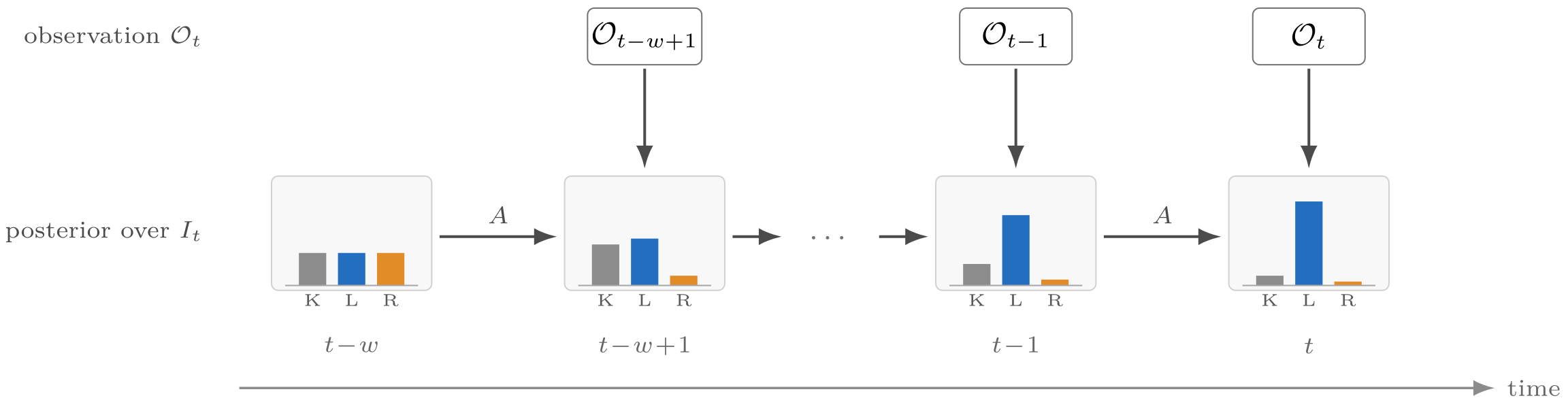
Figure 1: Sketch of the posterior evolution in the recursive Bayesian filtering approach for a left-change example.
Figure 1 illustrates the recursive evolution of the posterior distribution over driving intentions. In this example, the posterior concentrates on the intention class $L$, indicating a change to the left lane. Starting from a uniform prior distribution at time $t-w$, the model accumulates evidence for class $L$ over a window of length $w$, taking the incoming observations as well as the previous posterior distribution into account.
A key component of this framework is estimating the observation likelihood. We investigate two complementary approaches. The first employs Gaussian Mixture Models (GMMs) to represent the class-conditional distribution of observations. An important advantage of this generative formulation is its ability to handle missing observations through analytical marginalization, without requiring artificial replacement values. The second approach employs a Gradient Boosting Machine (GBM) as a discriminative classifier. To incorporate its predicted posterior probabilities into the Bayesian filtering framework, we apply a scaled-likelihood transformation. This transformation enables the GBM to provide observation likelihoods for recursive inference while leveraging its ability to handle higher-dimensional feature representations.
We evaluate the proposed framework using the highD dataset, which contains naturalistic vehicle trajectories recorded by drones on German highways at a sampling frequency of 25 Hz. Our compact observation representation comprises 16 features, combining the target vehicle's longitudinal and lateral velocities and accelerations with the relative distances and velocities of six surrounding vehicles.
To assess robustness to imperfect sensing, we simulate two observation dropout mechanisms: independent random dropout and temporally correlated bursty dropout. While the GMM handles incomplete observations through marginalization, we evaluate the GBM-based approach using different imputation strategies, including Last Observation Carried Forward (LOCF). The evaluation considers predictive accuracy, robustness to missing observations, temporal consistency, probability calibration, and computational efficiency.
A model may correctly classify driving intentions while assigning confidence levels that consistently overestimate or underestimate the observed frequency of those events. For instance, if a model predicts an 80% probability of a lane change across many comparable situations, about 80% of those situations should result in a lane change for the predictions to be well calibrated. We therefore investigate probability calibration for reliable intention anticipation.
The calibration analysis considers both class-wise probabilities and the combined probability of a lane change. We evaluate three post-hoc calibration methods applied to the probability estimates produced by the recursive Bayesian filter:
A key advantage of post-hoc calibration is that it can improve the reliability of probability estimates without retraining the underlying prediction model. This is essential for autonomous driving, where these estimates can inform downstream motion planning and risk assessment.
The experiments demonstrate that the GBM-based Bayesian filter maintains high predictive performance even under substantial observation loss. For a four-second prediction horizon, the GBM–LOCF approach achieves 94.5% balanced accuracy with complete observations and retains 94.1% when 80% of neighbouring-vehicle observations are unavailable. These findings highlight the importance of appropriate missing-data strategies in maintaining robust intention estimates under incomplete sensing conditions.
Beyond classification accuracy, we investigate whether the predicted intentions remain consistent over time. Compared with a stacked-GBM baseline, the recursive Bayesian filter reduces the prediction-label flip rate by about one-third while maintaining comparable predictive accuracy. The filtering approach also improves sustained anticipation by reducing unnecessary fluctuations in predicted intentions before the actual lane crossing. This suggests that recursive filtering can provide more temporally stable estimates while preserving the ability to anticipate upcoming maneuvers.
For the GBM-based model, isotonic regression reduces the lane-change Expected Calibration Error (ECE) from 0.056 to 0.022, and balanced accuracy increases from 94.4% to 95.0% in the calibration evaluation. These findings demonstrate that probability calibration can improve the reliability of intention estimates without compromising predictive performance.
Our experimental implementation of the GBM-based recursive filter achieves an average inference time of approximately 0.017 milliseconds per frame, which is well-suited for real time applications.
Our findings show that robustness to incomplete observations, temporal consistency, and well-calibrated probability estimates are important for supporting safety-critical decisions in autonomous driving. The proposed recursive Bayesian framework offers an interpretable and computationally efficient approach to these challenges. Further evaluation across diverse traffic conditions and integration into real-world autonomous driving platforms remain important directions for future research.
This research was conducted as part of the Short-Term Scientific Mission (STSM) at the University of Graz, supported by COST Action CA24136 InterCoML.
During the two-week visit, the welcoming, inspiring, and highly supportive research environment at the IDea_Lab, together with the invaluable guidance from Hendrik Kleikamp and discussions with Martin Holler and Bruno Viti, strengthened my ability to conduct independent research, critically evaluate methodological choices, and collaborate in an international research environment.
I particularly valued the opportunity to discuss questions directly, review the numerical results collaboratively, and consider alternative approaches as the research progressed.
Importantly, our collaboration continued beyond the STSM and led to our joint research paper, "Robust Lane-Change Intention Anticipation under Uncertainty Based on a Recursive Bayesian Filtering Approach" , which is currently under review.
I am grateful to COST Action InterCoML for making this research visit possible, for providing the opportunity to exchange knowledge and ideas, and for fostering international scientific collaborations.

Budapest University of Technology and Economics, Hungary

University of Graz, Leechgasse 34, 8010 Graz, Austria