Optimal control problems are ubiquitous in engineering and science. However, solving them efficiently, especially for parameter-dependent systems, remains computationally demanding. Machine learning (ML) has emerged as a promising tool for accelerating these solutions, but rigorous error certification is required when approximating the optimal control in safety-critical applications.
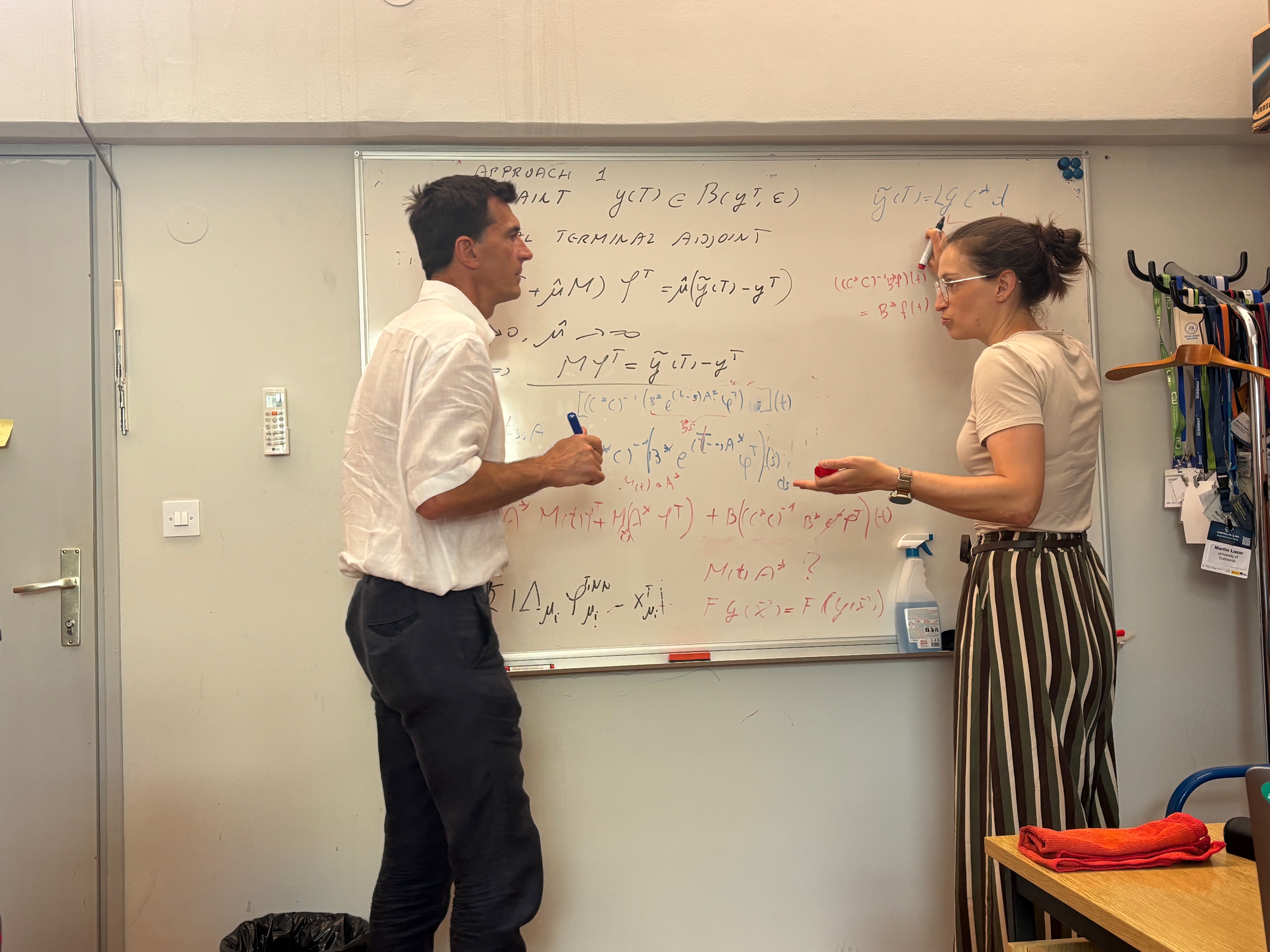
The STSM focused on an ML-enhanced optimal control framework for constrained optimal control problems involving the penalization of deviation from a desired trajectory which is particularly challenging to solve using classical numerical methods.
The follow-up research activity will focus on deriving suitable expressions for the optimal control to make the problem amenable to a physics-informed neural network (PINN) approach with rigorous error bounds. The PINN will then provide an approximate solution to the Lyapunov differential equation, enabling the optimal control for a specific parameter and target state to be computed easily.
Unlike conventional reduced-basis methods, the proposed project will develop an approach that does not require data generated using classical numerical solvers. This strategy promises to reduce offline computational costs and accelerate online costs significantly.
Karlsruhe Institute of Technology, Germany
Sveuciliste U Dubrovniku, Branitelja Dubrovnika 41, 20000 Dubrovnik, Croatia