
The STSM focused on developing a physiological stress detection methodology and applying it to investigate the relationship between physiological stress dynamics and decision-making in strategic economic interactions, in collaboration with researchers at the Institute of Information Theory and Automation (UTIA).
Building on previous work in machine learning-based stress classification, the mission addressed both methodological adaptation and the development of an experimental framework for studying decision-making under stress. Due to technical issues with the photoplethysmogram sensor during the stay, the physiological sensing protocol was adapted to rely on galvanic skin response and skin temperature. New features, including dynamic parameters capturing real-time physiological changes, were engineered, and several machine learning models (CatBoost, ExtraTrees, and XGBoost) were evaluated. Among the tested approaches, XGBoost demonstrated the best performance in binary stress classification (0/1).
To investigate the role of physiological stress in strategic interactions, an experimental framework based on the Nash Demand Game was designed and implemented at UTIA. This involved developing a custom game kernel and a user-friendly graphical interface to support real-time monitoring of participants' choices, demands, and payoff outcomes under stress-inducing conditions. In addition, device-tracking plugins and a MATLAB-based preprocessing module were developed to capture detailed interaction dynamics, including device activity patterns, hesitation, and decision latency during bargaining.
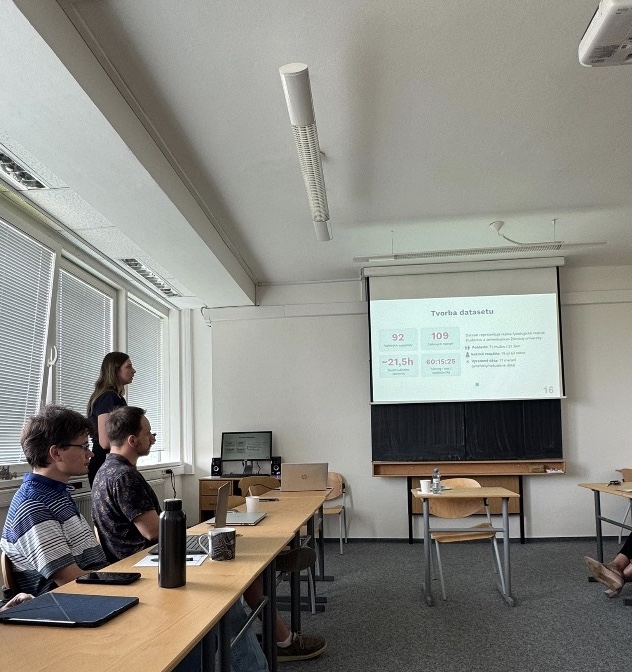
By integrating real-time physiological stress classification with strategic gameplay decisions and device-tracking data, the framework moves beyond treating economic decisions as isolated outcomes and enables their investigation as dynamic processes shaped by evolving physiological states and interaction behaviour. Knowledge exchange was further supported through a lecture on biosignal-based stress detection. The resulting framework establishes a methodological and experimental foundation for an upcoming joint publication based on an expanded experimental study.
University of Žilina, Univerzitná 8215/1, 010 26 Žilina, Slovakia