Welcome on the webpage of the COST Action InterCoML! The main aim and objective of the Action is to boost applications of tools from Control Theory to Machine Learning and vice versa, and to explore the great applicative potential that can be released by combining these two rapidly evolving research areas.
Find out moreYou want to become part of the Action and receive information about upcoming events? Just create an e-COST account and apply for membership in the working groups you are interested in!
Apply hereWorking group 3 will have its virtual kickoff workshop on 12 December, 2025.
Find out moreWorking group 2 will have its virtual kickoff workshop on 5 December, 2025.
Find out more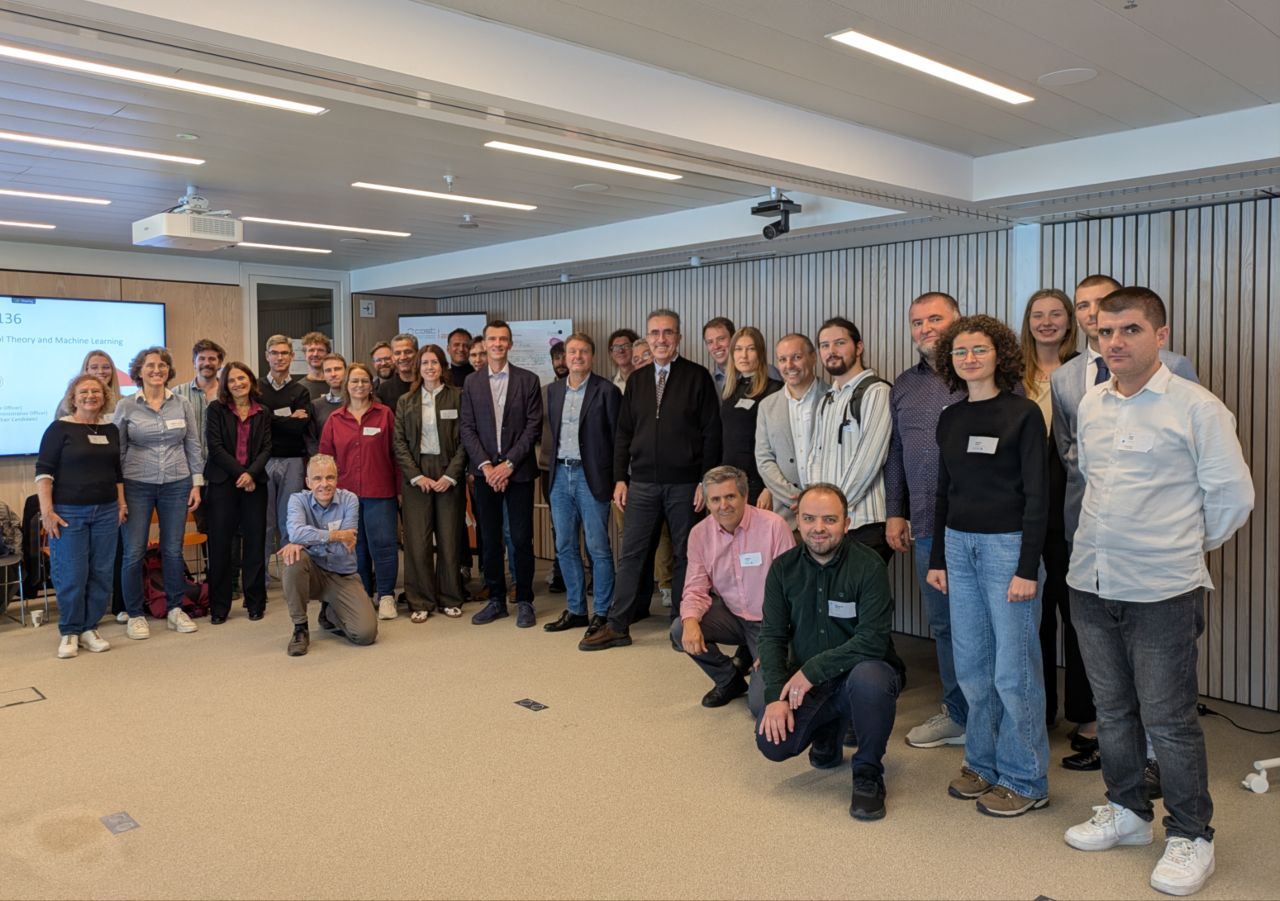
The COST Action had its initial MC meeting on October 10, 2025, in Brussels, Belgium. We are up and running and looking forward to four exciting years of connecting researchers across Europe!
The advent of the control theoretic perspective on learning with deep residual neural networks has recently been shown to be not only a reliable computational tool, but also a fruitful avenue for providing original theoretical results to a multitude of problems. These include adversarial robustness, generative modelling and generalisation bounds, to name a few. Similarly, dynamic Bayesian networks, which are the central paradigm in statistical ML, can be analysed with the help of classical CT tools like Kalman filters. The aim is to explore these connections and contribute to the mathematics of reliable ML.
More Information
This working group addresses the application of ML tools, such as kernel methods and deep neural networks to complex models in control theory. These will be combined with traditional control methods, either on the algorithmic level for developing enhanced and provably efficient novel techniques, or for analysis purposes, in order to better understand the opportunities and limitations of ML for the control design. The focus will be on the development of techniques that can handle high-dimensional problems and face the curse of dimensionality.
More Information
The aim is to address control problems built on observed pairs of input-output data. The Action will develop efficient and reliable methods for designing controllers when the underlying model is unidentified or when the underlying laws and processes only allow partial knowledge. While these topics arise in a wide range of potential applications, the Action will focus on control of power systems (solar, wind, smart houses) and construction of digital twins in healthcare and personalised medicine. In connection with industry partners, the Action will explore implementation options that can provide benefits for clean energy and improve healthcare outcomes of European citizens.
More Information
WG4 will be responsible for transforming theoretical results into software solutions and practical implementations in industry and society. Its activities are essential for bridging the gap between theory and real-world applications, ultimately ensuring the relevance and accessibility of the findings to the broader community. Special attention will be given the following activities:
The aim of WG5 is to provide communication channels that will allow for efficient and timely transfer of knowledge among Action members and towards a wider audience. In particular, to produce a dynamic overview of the progress achieved and the current state of the art (the results, developed codes, open problems, industrial perspectives) that will be immediately available to the other WGs, and later to all the interested researchers. Special attention will be paid to the problems of fragmentation of communities interested in CT, ML and their applications. This WG will help to tackle the challenge that the same or closely related problems/methods are known by different communities under different names, and cross-references are not clearly established.
More Information